
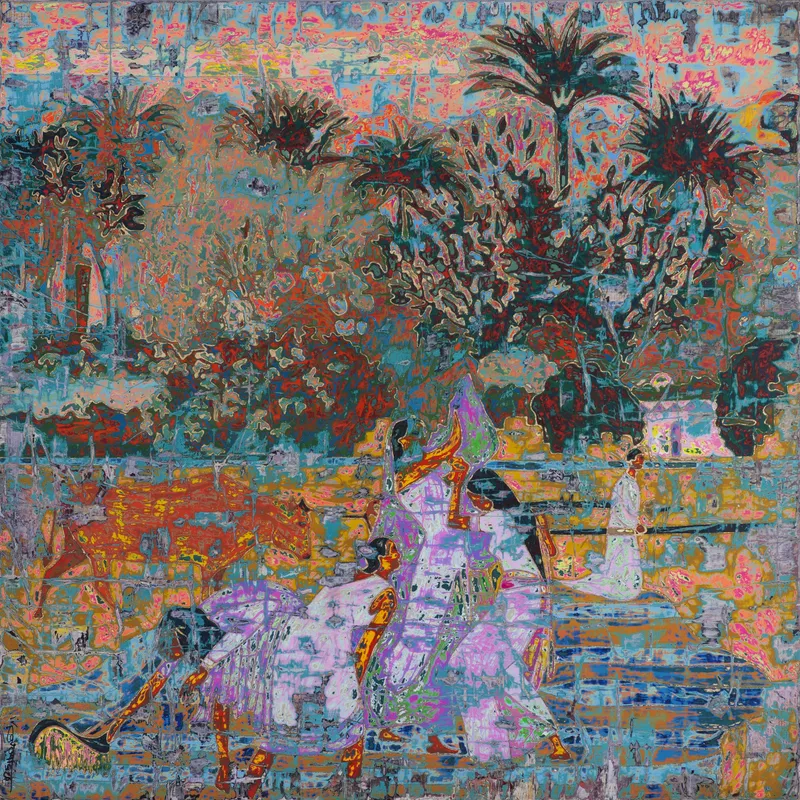
'The Inner Nile’ denotes a visual exploration of the Egyptian landscape as a psychological and evolutionary construct. In this body of work, the Nile is no longer just a life-giving geographical artery, but a fluid state of consciousness that courses through the veins of the collective conscience and memory. By dissolving the boundaries between biological beings and the terrain, the exhibition proposes that we do not merely live beside the river or because of it, but that the river, with its ancient mud and timeless waters, flows eternally within us.
Perhaps our most anticipated exhibition of the 2025/26 season, Safarkhan resident talent Ibrahim Khatab’s latest collection, ‘The Inner Nile’ will open April 1st. Since his last exhibition during our 2023/24 season, Khatab has cemented his status as one of the Middle East’s most sought after artists, now being a regular fixture in continental art fairs from Nigeria to South Africa to Abu Dhabi, amassing a burgeoning following across global art circles, with his works becoming fixtures in reputed art collections around the world. Khatab’s signature brand of layered abstract-figuratism allows him to produce paintings replete with depth, detail and a beautified aesthetic underpinned by an unusual and paradoxical harmonization of realism with abstraction. It is this duality that attributes Khatab’s art its innate uniqueness and thus its almost universal appeal, in each and every work, there is so much to witness and digest, yet also as much if not more, is left concealed under a shroud of mystery to extrapolate and ruminate over. A self-developed compositional technique of chemically-treated multimedia layering accentuates a myriad of aesthetic qualities that synergize to establish the finely-tuned visual archetype Khatab is so beloved for, establishing a unique aesthetic of visual sedimentation, layering pigments like silt to create a “geology of the canvas.” ‘The Inner Nile’ thus denotes a visual exploration of the Egyptian landscape as a psychological and evolutionary construct. In this body of work, the Nile is no longer just a life-giving geographical artery, but a fluid state of consciousness that courses through the veins of the collective conscience and memory. By dissolving the boundaries between biological beings and the terrain, the exhibition proposes that we do not merely live beside the river or because of it, but that the river, with its ancient mud and timeless waters, flows eternally within us.
This collection is an invitation to navigate a landscape where the topography of the terrain and the anatomy of the soul are one and the same. The scenes Khatab captures, despite being relatable in their authenticity, appear almost as though one is peering behind the veil into the breathtaking power of a heavenly abode, untouched and untainted by the sin of man. The conceptualization of ‘The Inner Nile’ becomes apparent in Khatab’s foray into a considerable number of paintings that retain the focus exclusively or almost exclusively upon the landscape and topography, devoid of human beings, animals, deconstructed calligraphic forms or man-made objects. In these works, we witness an uncanny constitution of natural setting, they appear intensely relatable and identifiable, yet at the same time as though they were from another realm, steeped in an awe-inspiring veneer of mysticism. This is representative of the duality of the concept of ‘The Inner Nile’ – in its physical temporal nature and contrastingly in its figurative metaphorical sense to the viewer. Khatab advances this conception using a brilliant palette, always the avid and adventurous colorist, this time we find him uncovering new tones and hues that accentuate such notions; luxurious, regal violets, lilacs and mauves, scintillating aurelian yellows and oranges, and a captivating spectrum of pulsating blues and greens, which along with brown, are the predominant colors of the natural world.
Khatab also habitually ventures into the domain of symbolism as he is known to do. Motifs such as the palm, lotus, oxen and mules emerge not merely as flora and fauna, but as structural anchors — icons of resilience and renewal that bridge the gap between the outer and inner, the terrestrial and the spiritual. Vessels voyaging along waters that bear their burden and guide their passage, ritualistic movement, pose and dance as a form of reverence that human beings offer within and to their surroundings, and enigmatic lone shrouded and gilded figures appearing almost as if apparitions rather than physical beings, portend notions of prophethood and prophecy. What Khatab has managed to achieve in this latest body of work is a self-assured stride into new territory as an already accomplished artist. We see a definitive evolution of palette and subject matter, which in many cases is achieved through a paring back of the various aspects he fills his canvases with, using less form to create more meaning. This in turn demonstrates a maturity of conscience and thought, the development and progression of which engenders a meaning and message behind each of these stirring works of art. This not only enhances their resonance with the viewer, but causes them to contemplate their own interpretation of what ‘The Inner Nile’ means to them.
