
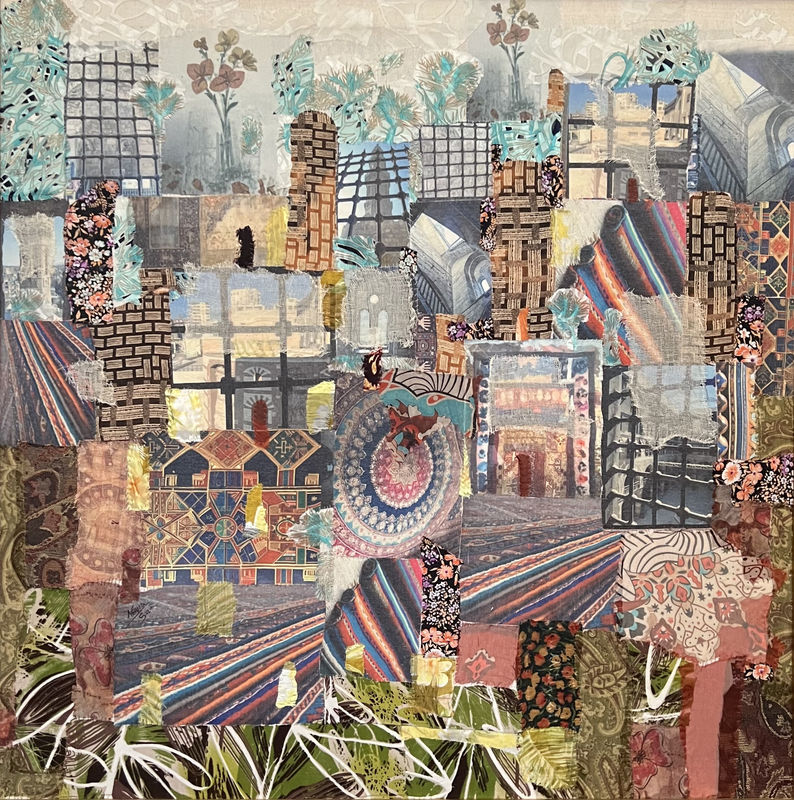
Neama’s works draw upon a rich convergence of cultural symbols, and go beyond being elaborate and endearing visual tapestries of civilizational influences, they are an artist’s attempt to simultaneously connect the threads of our past, present and futures. Neama’s canvases astutely weave together elements from Ancient Egyptian, Coptic, Islamic, Greco-Roman, and contemporary classifications — all filtered through her own one-of-a-kind contemplative approach to abstraction.
Neama El Sanhoury delivers her third collection since joining the Safarkhan family of artists from Wednesday 14 January to Wednesday 11 February, 2026. Neama’s unique method of fabric appliqué tapestries create the effect of ‘painting with fabric’, establishing an aesthetic that is paradoxically novel yet nostalgic. El Sanhoury’s work lovingly reflects the richness of oriental heritage, yet one she also nobly intends as a reminder of generosity and sustenance that younger generations must carry into the future. Neama’s art both elevates and immerses, reviving a medium and a message that might otherwise fade from memory. Blending the allure of the old world with a modern sensibility — one that steadfastly preserves the insight carried by time, this contrast allows El Sanhoury to convey the core message of her practice: that our past must be honored and protected if we wish to secure a prosperous future. Her pieces evoke the weathered presence of an ancient artifact, filled with untold stories, where even the holes, gaps and fragmented pieces of fabric tell their own textured stories. Neama’s works draw upon a rich convergence of cultural symbols, and go beyond being elaborate and endearing visual tapestries of civilizational influences, they are an artist’s attempt to simultaneously connect the threads of our past, present and futures. Neama’s canvases astutely weave together elements from Ancient Egyptian, Coptic, Islamic, Greco-Roman, and contemporary classifications — all filtered through her own one-of-a-kind contemplative approach to abstraction.
In Neama’s creative output, memory becomes architecture, and architecture becomes a living archive of movement, ritual, and cultural continuity. Each piece is a tapestry of fragments — patterned fabrics, ornamental motifs, architectural silhouettes, and scenes of collective presence — stitched and assembled into beautified amalgamations. The result is not merely a constructed image, but a reconstructed world: one in which heritage is not static but dynamically re-inhabited through texture, rhythm, and spatial compression. Across the series of works seen in this collection, the artist collapses time and geography, merging traditional textile patterns with modern ones. Imagery of urban passageways, courtyards, windows, and ceremonial gatherings appear as if excavated, reinterpreted, or remembered across generations. The collages suggest human settlements as palimpsests — sites written and rewritten by human movement and cultural exchange. Carrying warmth, weight, drape and protection, the surfaces of these works feel intentionally tactile and quilt-like, almost as if inviting the viewer to caress and intimately connect with their textile surfaces. Sewing and stitching becomes a metaphor for connection — a quiet assertion that culture is sustained not only through monumental edifying structures, but through everyday acts of making, mending, preserving, and contrastingly, not least in the most delicate of materials.
Textiles recall how communities and cultures express identity, belonging and the exchange and movement of ideas. Bustling mosaics of fabric and cloth where patterned borders, carved doors, market scenes, and fragments of painted frescoes intermingle. Archways and doorways are figurative passages into memory, adventure, and storytelling. Architectural grids interlock with offcuts from carpets, garments, upholstery and beyond, creating a meditative visual choreography of repetition and variation. It conjures spaces of gathering — courtyards, prayer halls, or communal interiors — where pattern and space echo one another in rhythmic harmony. Ceremonial scenes unfolding within ornate borders, where clusters of robed figures appear almost as patterned elements themselves, merge the creative with the sacred, with some of these works appearing as woven devotional cloths. Together, these artworks form an intricate meditation on cultural legacy — how it is carried, transformed, layered, and reimagined. These works celebrate the conversation between tradition and reinvention, foregrounding the intimate relationship between place, pattern, and the human experience. The viewer is invited to wander, discover, and piece together meaning. Neama El Sanhoury reminds us that this inheritance is not an unbroken line — it is a mosaic of fragments lovingly preserved, reassembled, and given new life for future generations.
